


President of the Conference
Dr Lazhar Ayed
Associate Professor of Energy Engineering, University of Gafsa; lazhar.ayed21@gmail.com
Conference
The “International Conference on Scientific and Pedagogical Mechanics and Energy” has a storied history that began in 2003 with its inception as the “Journées Scientifiques et Pédagogiques de Mécanique et Energétique” in the Higher Institute of Technological Studies of Gafsa, Tunisia. This initial phase was marked by significant success, establishing a strong foundation in the scientific and pedagogic community. By 2005, the growing recognition and international interest led to its evolution into the “International Journal of Scientific and Pedagogic Mechanics and Energetics,” reflecting its expanded global reach and influence. In 2024, plans for a “renaissance” of the conference were announced, setting the stage for a revitalized gathering in April 2025 in Gafsa, Tunisia, promising to bring fresh perspectives and renewed energy to the academic and scientific discussions.
Ultimate Extended Submission Deadline:
March 31th, 2025
In response to high demand from many participants, the submission deadline has been extended to March 31, 2025. This extension provides additional time for researchers and professionals to contribute their latest findings and be part of this important academic gathering.
Paper should be formatted according to the proposed template:
Please See SUBMIT ARTICLE


The presented and selected papers will be published in one of the books or the journal, displayed in the carousel below (see details in PUBLICATION):


ICSPME, 3rd Ed Event: April 10-11-12, 2025 in Gafsa, Tunisia
Journey
International Conference on Scientific and Pedagogic Mechanics and Energy has a brief but a rich history of bringing together thought leaders, innovators and enthusiasts from around the world to discuss and advance the field of Scientific and Pedagogic Mechanics and Energetics. Here’s a look at our journey over the years:
Inception
Year of Inception: 2003
The International Conference on Scientific and Pedagogical Mechanics and Energy was founded in 2003 under the name of “Journées Scientifiques et Pédagogiques de Mécanique et Energétique” with the vision of creating a platform for Scientific and Pedagogic Mechanics and Energetics. The inaugural conference was held in Gafsa, Tunisia, attracting 50 participants and setting the stage for future growth. This initial phase was marked by significant success, establishing a strong foundation in the scientific and pedagogic community.
Expansion
2005: Growth and Recognition
As the conference grew in popularity, it became international as the International Days of Scientific and Pedagogical Mechanics and Energy, reflecting its expanded global reach and influence. The international conference was held in Gafsa, Tunisia, attracting 80 participants and setting the stage for future growth. This phase was marked by an expanded global reach and influence.
Renaissance
2025: Innovation and Impact
A “renaissance” of the conference is announced, setting the stage for a revitalized gathering in April 2025 in Gafsa, Tunisia, promising to bring fresh perspectives and renewed energy to the academic and scientific discussions.
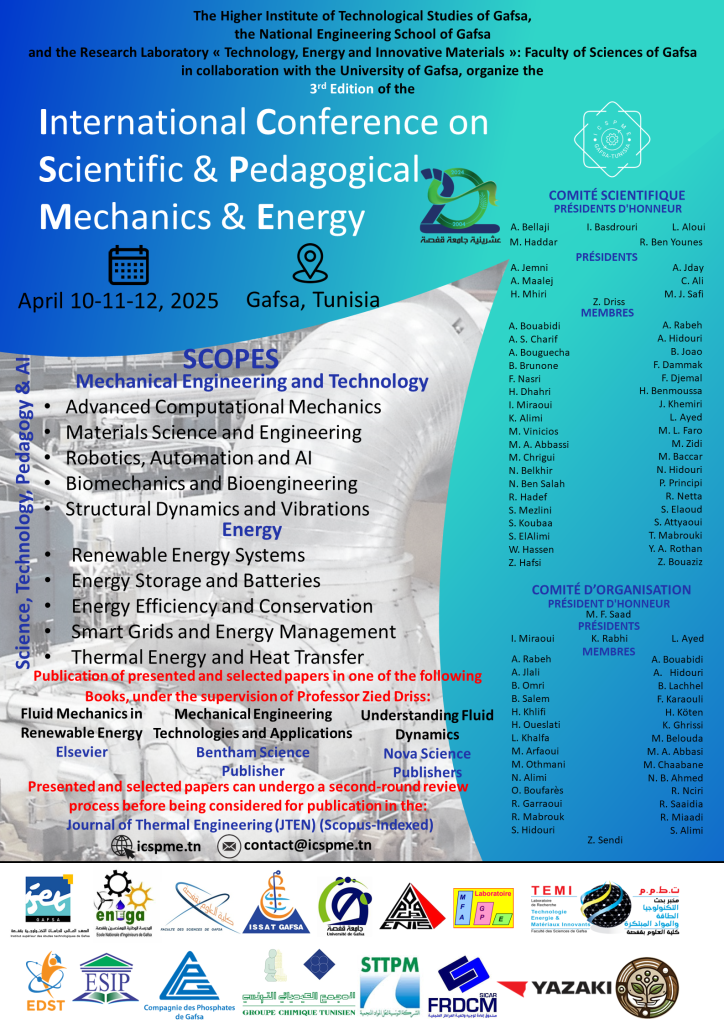
SCOPES
Scientific, Technological, Pedagogical and AI research works are encouraged in the scopes:
Mechanical Engineering & Technology
Advanced Computational Mechanics
This area explores the development and application of numerical and computational methods for solving complex mechanical problems. Topics include finite element analysis (FEA), computational fluid dynamics (CFD) and the use of machine learning in optimization and predictive modeling. These techniques are applied to simulate and analyze structural, thermal and dynamic behavior in various engineering domains.
Materials Science and Engineering
This scope covers the study of material properties and how they can be engineered to meet specific mechanical and energy-related requirements. It includes topics such as nanomaterials, smart materials, composites and the relationship between material structure and performance. Innovations in materials are essential for advancements in mechanical systems, energy efficiency and sustainability.
Robotics, Automation and AI
Robotics, automation and artificial intelligence (AI) deal with the design, development and application of robotic systems, automated processes and intelligent algorithms. This includes both hardware (robots, actuators, sensors) and software (control algorithms, AI technologies) that enable machines to perform tasks with precision, adaptability and efficiency. Applications span manufacturing, healthcare, transportation, energy systems and beyond, revolutionizing industries through innovation and intelligent automation.
Biomechanics and Bioengineering
This field focuses on the application of mechanical principles to biological systems. Biomechanics studies the mechanical aspects of living organisms, such as human movement and tissue behavior under stress, while bioengineering develops technologies for medical applications, such as prosthetics, implants and regenerative medicine. Innovations in this field enhance healthcare outcomes and assistive technologies.
Structural Dynamics and Vibrations
Structural dynamics examines the behavior of structures under dynamic loading conditions, including vibrations, seismic forces and impact. It involves studying the response of materials and systems to external forces and optimizing designs to prevent failure due to excessive vibrations or resonance. This area is critical in fields like civil engineering, aerospace and mechanical design, where safety and reliability are paramount.
Energy
Renewable Energy Systems
This scope focuses on the generation of energy from renewable sources such as solar, wind, hydro, geothermal and biomass. It explores the technologies, challenges and innovations that make renewable energy a sustainable alternative to fossil fuels. Topics include energy conversion efficiency, grid integration and the role of renewable energy in reducing carbon emissions and promoting sustainable development.
Energy Storage and Batteries
Energy storage technologies, particularly batteries, play a key role in enabling the widespread adoption of renewable energy by addressing intermittency issues. This area covers developments in battery technologies (e.g., lithium-ion, solid-state and flow batteries) and other storage methods (e.g., pumped hydro, compressed air) for efficient energy management. Research focuses on improving energy density, cycle life and charging efficiency to support grid stability and electric vehicles.
Energy Efficiency and Conservation
This field focuses on reducing energy consumption while maintaining or improving system performance. Topics include energy-efficient technologies for buildings, transportation and industrial processes, as well as strategies for behavior change and resource conservation. Innovations in this area aim to minimize energy waste, optimize the use of available energy and reduce environmental impacts, contributing to sustainability goals..
Smart Grids and Energy Management
Smart grids use digital technology and advanced sensors to improve the efficiency, reliability and flexibility of the electricity grid. This scope covers the integration of renewable energy sources, demand-side management, real-time data analytics and automated control systems. It aims to create a more resilient and adaptive grid that optimizes energy distribution and consumption, while ensuring system reliability and cost-effectiveness.
Thermal Energy and Heat Transfer
Thermal energy and heat transfer are crucial to many energy systems, including power generation, heating and cooling and industrial processes. This area explores the mechanisms of heat transfer (conduction, convection and radiation) and how to optimize thermal systems for improved energy conversion and utilization. Topics include heat exchangers, thermal storage and the development of advanced materials to enhance heat transfer efficiency in renewable energy systems, industrial applications and energy-saving technologies.
ORGANIZERS

ACADEMIC PARTNERS




ASSOCIATIVE PARTNER
Association of Scientific Skills of Gafsa
Location: Faculty of Sciences, Gafsa
Type: Scientific Association
Established: January 2012
Objectives:
- Establish a scientific skills network to leverage knowledge and expertise for the benefit of the region.
- Organize scientific seminars on topics relevant to the region and promote collaboration between the university and the socio-economic sector.
- Provide training for researchers, students and personnel from socio-economic institutions.
- Foster cooperation with other universities in Tunisia and abroad.
Activities:
- Hosting visiting professors.
- Organization of MPM congresses (2017–2019) and CME (2023).
- Training programs for doctoral students in chemistry.
- Workshops on chemical safety.
INDUSTRIAL SPONSORS



Gamma Tunisie Contact
ICSPME